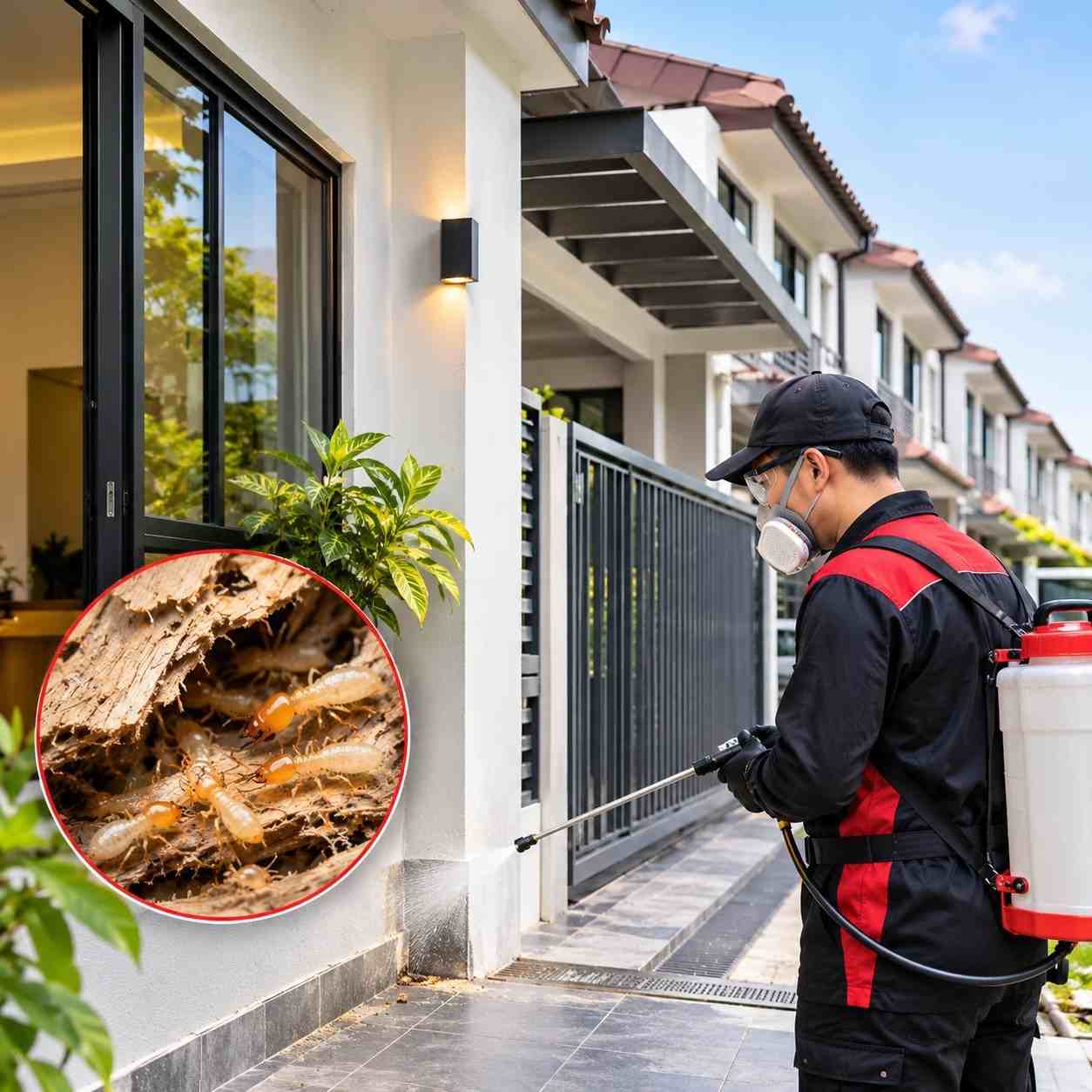
Termite Treatment for Terrace Houses in Malaysia

Terrace houses make up a huge share of Malaysia’s housing stock, and that shared-wall layout is part of why termites spread through entire rows of them instead of staying put in one unit. If your neighbour’s had an infestation in the past year or two, there’s a decent chance the colony’s already working its way toward your side of the wall.

termite treatment terrace house
Why Terrace Houses

Why Terrace Houses Are High-Risk for Termites

A few things stack together here. Terrace houses share party walls with the unit on either side, so a colony doesn't need to find a new entry point once it's established, it just keeps moving along the same foundation line. Most terrace homes built from the 1980s through early 2000s also used a fair amount of structural timber, door frames, roof trusses, sometimes staircases, without the termite-proofing standards that newer developments follow.

Add Malaysia's humidity into the mix and you've got conditions that favour subterranean termites specifically. They need consistent moisture to survive, and a narrow terrace garden with soil banked up against the house wall gives them exactly that. Getting proper termite treatment for terrace houses isn't really optional in a lot of these older housing areas. It's closer to routine maintenance.

Request a Free Quote

Signs of Termites in Your Terrace House

Watch for these around the house, inside and out:

01

Mud tubes running along the party wall, foundation, or any external pillar

02

Hollow-sounding timber when tapped, especially door frames and staircase components

03

Wings scattered near a window or porch light after a humid evening

04

Doors that suddenly stick, particularly ones near the shared wall

05

Skirting boards that feel soft or look slightly warped

06

Fine debris near wooden fixtures that wasn't there a few weeks ago

Any one of these could be a one-off. A few showing up together, especially near a shared wall, usually means something's already moved in.

Our Termite Treatment Methods for Terrace Houses

Detailed Termite Inspection

Everything starts with a proper look at the property. Foundation, timber fixtures, shared walls, roof void, anywhere moisture tends to sit. For terrace houses specifically, the inspection also checks how close the infestation sits to the party wall, since that affects how the whole treatment gets planned.

Soil Treatment (Drilling and Injection)

A treated barrier goes into the soil around the foundation, and in terrace houses this often means drilling through the ground floor slab or driveway to reach soil that’s otherwise sealed off by concrete. Termites pick up the solution without detecting it and carry it back to the colony.

Termite Baiting System

Bait stations go in around the perimeter, wherever there’s accessible soil. Workers feed on the bait and share it with the rest of the colony through natural feeding behaviour, queen included. It takes longer, usually weeks, but it reaches the whole nest rather than just the visible activity.

Monitoring and Follow-Up

A single treatment rarely ends the story, particularly with shared walls in play. Follow-up visits confirm the colony’s actually gone, and because terrace houses share structure with neighbouring units, ongoing monitoring matters more here than it would for a standalone bungalow.

Soil Treatment vs Termite Baiting: Which Is Better for Terrace Houses?

Soil treatment is primarily a preventive solution, best applied during construction or renovation before any active termite infestation is detected. It helps protect the property against future termite attacks. On the other hand, baiting systems are designed for existing active termite infestations. Although baiting takes longer to work, it is one of the most effective methods for targeting and eliminating the termite colony at its source. For terrace houses, baiting is particularly useful when termite activity is already present, as the colony may extend beneath shared walls and into neighbouring properties.

How Our Termite Treatment Process Works

    1. Free inspection to assess the extent of the problem and check proximity to shared walls.
    2. A treatment plan built around what’s actually found, not a standard package.
    3. Application by trained technicians, using eco-friendly products safe for families and pets.
    4. Follow-up visits to confirm elimination.
    5. Prevention advice, mostly around moisture and soil levels around the house.

Termite Treatment Cost for Terrace Houses in Malaysia

A few things decide the final price. The size of the terrace unit matters, since a longer perimeter needs more bait stations or a bigger soil barrier. How far the infestation has spread plays a role too, early detection usually costs a fraction of what a severe case does. Whether drilling through a driveway or ground floor slab is needed can also add to the job, since that’s more labour-intensive than accessing open soil directly.

None of this means much without an actual inspection. A number quoted over the phone, without anyone looking at the property, is just a guess.

Why Choose PestGuard Solution?

PestGuard Solution starts every job with an honest inspection, not a price pulled out of thin air. The plan gets built around what’s actually found on site, including how close an infestation sits to a shared wall, which matters a great deal for terrace properties. Technicians train to proper safety standards, and the products used stay eco-friendly throughout.

FAQs

Frequently Asked Questions

Can termites spread from my neighbour's terrace house to mine?
Yes, through the shared party wall and foundation. It's one of the bigger risks specific to terrace housing.
How long does termite treatment for terrace houses take?
Soil treatment often shows results within a few days. Baiting takes longer, sometimes several weeks, since it's working through the entire colony.
Will drilling damage my driveway or flooring?
Technicians use small, discreet access points, and any holes get sealed afterward. It's a standard part of the process for terrace properties with concrete-covered soil.
Is this safe for kids and pets?
Generally yes, with trained technicians and approved products. If a specific area needs to stay clear for a short time, you'll be told beforehand.
How often should a terrace house be checked?
Once a year at minimum. If a neighbouring unit has had termites recently, checking sooner makes sense.

Get Your Free Termite Inspection Today

A sticking door near the shared wall, a faint mud line along the foundation, none of it resolves on its own. Book a free inspection and find out exactly what's going on before it spreads further down the row.

Contact us